Conditional Select
Let one field filter the options that a Select (single) or Select (multi) field shows.
A select field can filter its options based on the value of another field on the same record. Use this when two fields are related and the second field’s options only make sense for some values of the first.
For example, a Country field can control a City field. When a record’s country is Germany, the City field offers Berlin, Munich, and Hamburg. When it is France, the same field offers Paris and Lyon.
Enable option filtering
Organization Owners and Admins, and workspace Project Administrators, configure this in the settings of a Select (single) or Select (multi) field:
- Open the field’s settings and enable Filter options by another field.
- Choose the Controlling field.
- Under Visible options, choose the options to show for each controlling value.
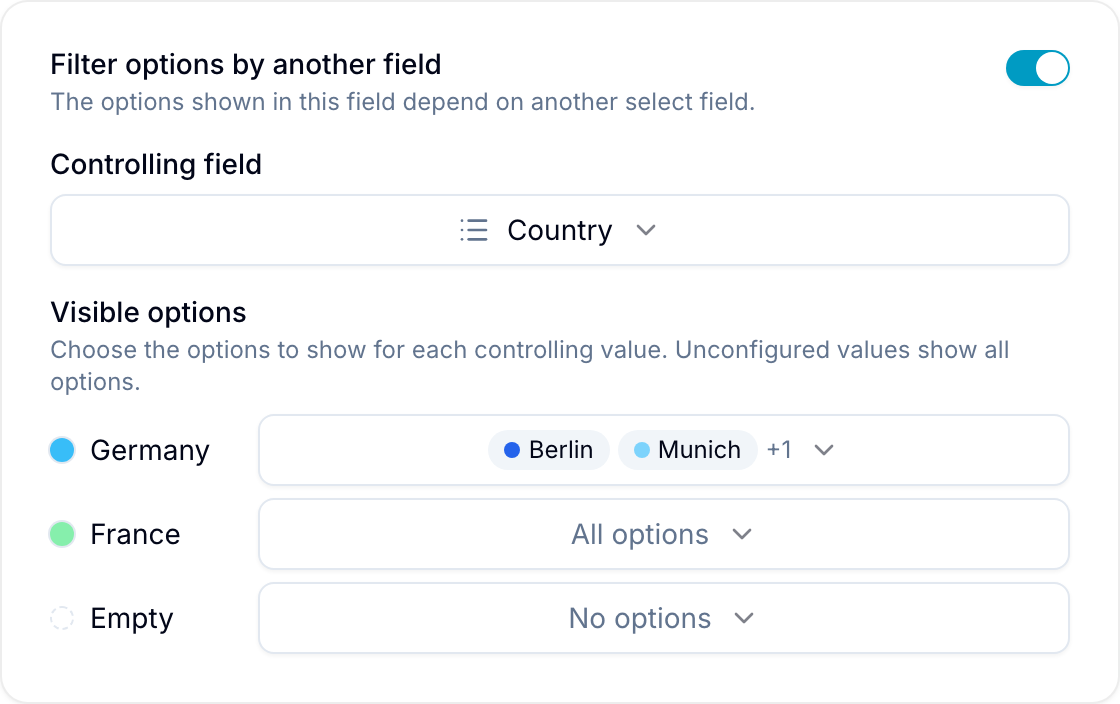
The controlling field can be a Select (single), a Select (multi), or a Reference field. For a Reference field, each linked record is a controlling value. A field cannot control itself, and control cannot loop back on itself. A field can be controlled by one field and control another.
Visible options
Each controlling value has its own rule:
- All options: the default. Values without a rule show every option, so a field never ends up empty.
- A specific set of options: pick the options that value allows. Blue shows only these.
- No options: the field offers nothing for that value.
The Empty row sets the rule for records where the controlling field has no value.
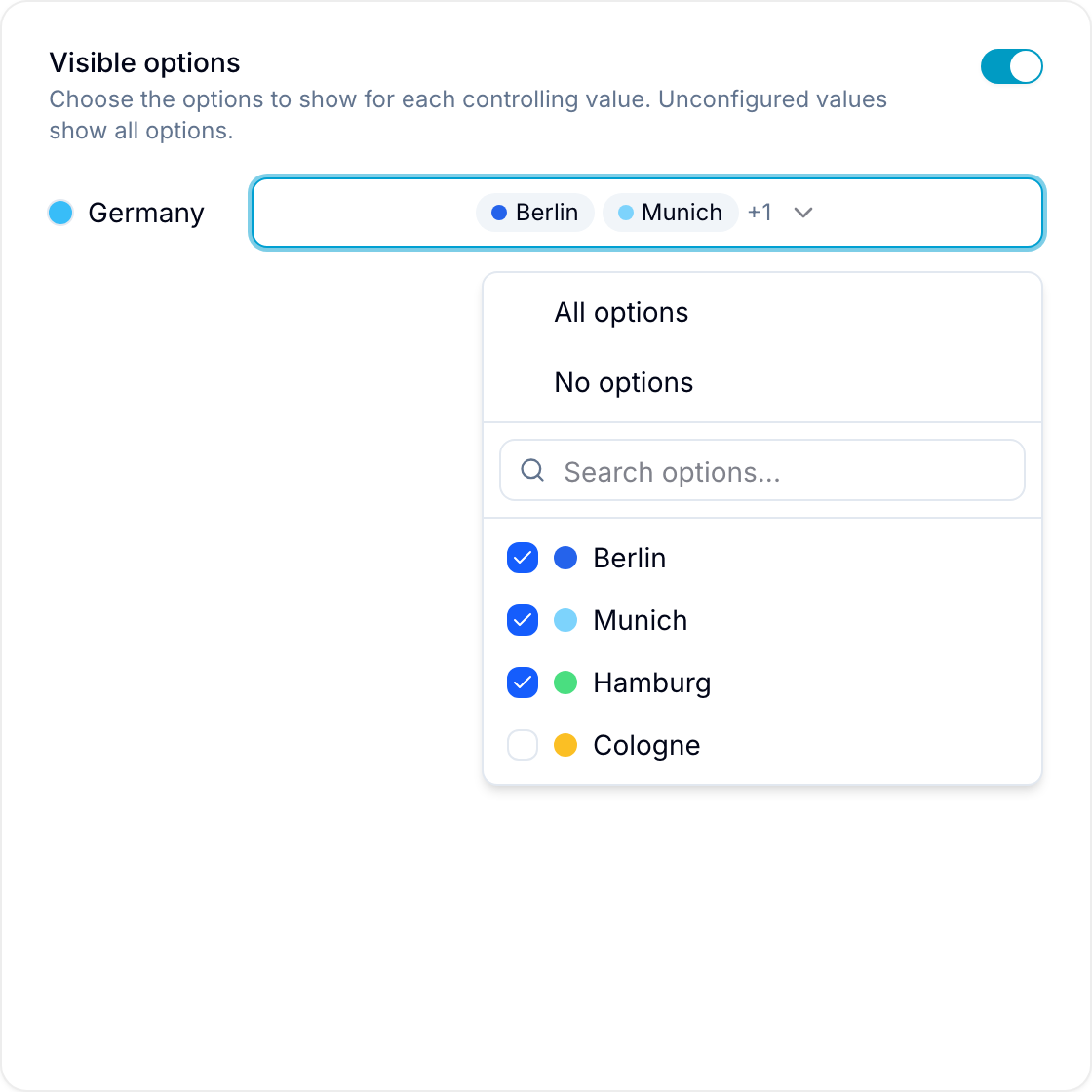
When the controlling field has several values, Blue shows every option that any of them allows. If any selected value has no rule, Blue shows all options.
Where it applies
Filtered options appear wherever you pick a value for the field:
- On records and in Table cells.
- In public forms, with no extra setup. People who fill in the form see the same filtered options.
Filtering rules belong to the field. Copying a workspace or using a template carries the rules and the controlling relationship to the copy.